
Bullshit Tokenism like International Women's Day
and the tragedy of the disappearing class lens

I like Faye’s journalism. This is not about her. I’m using her post to highlight a problem I have with a particular type of lazy analysis that has pervaded the universe, from casual conversations to journalistic thought pieces.
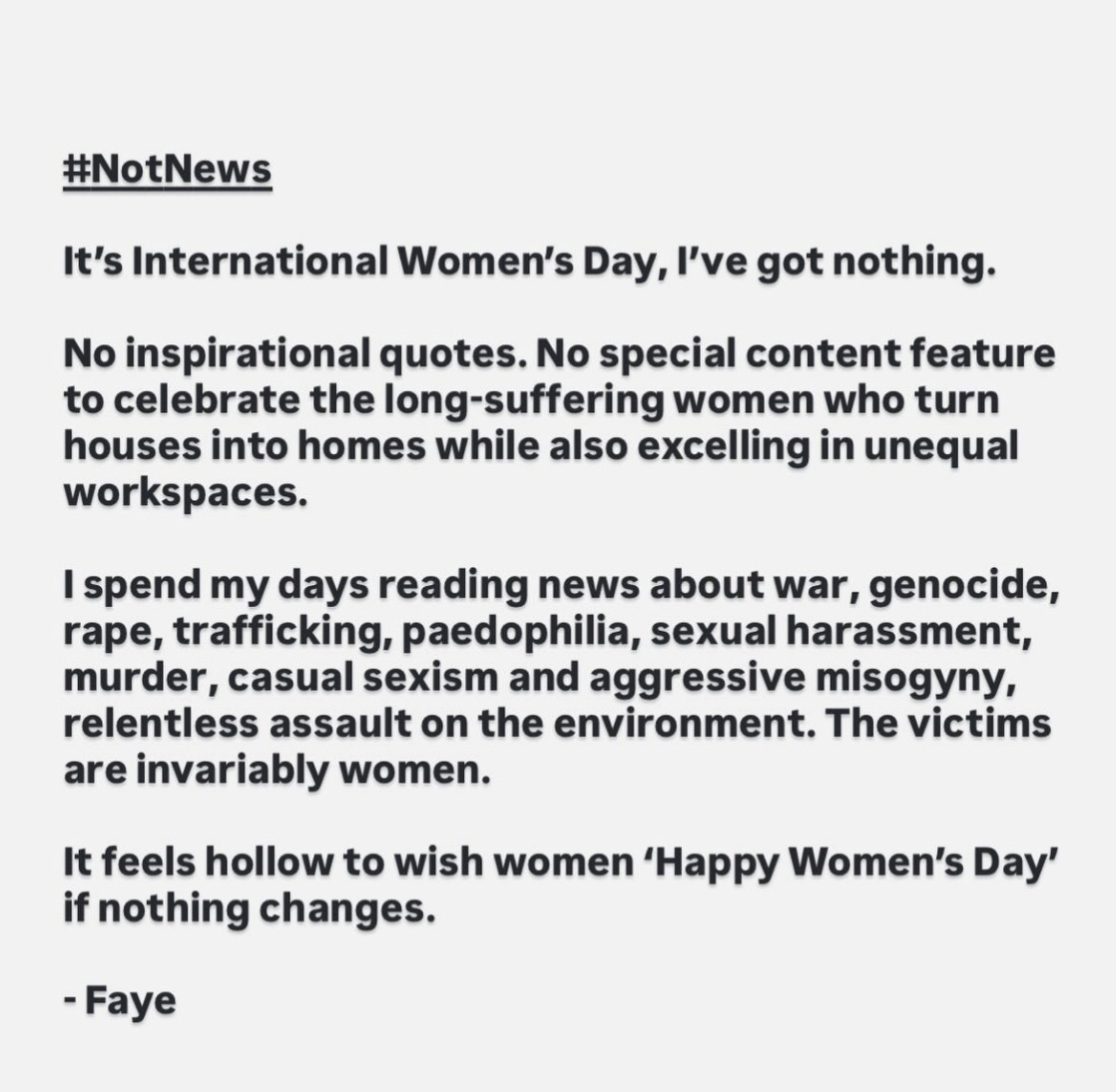
She says that the victims are “invariably women”. But the victims are not only women.
The victims are women, men, boys, girls, dalits - anyone who is not RICH. The victim is anyone who does not have the money to buy a chartered flight out of a bomb zone, a second home in Morocco, an offshore bank account in the Cayman Islands, and the phone number of a minister.
When you look at everything through an identity lens (gender/queer), particularly war and genocide, then all you get is bullshit tokenism like Women’s Days and Black History Months. I’d have no real problem with bullshit tokenism if it did not come at the expense of real policy change. And my hypothesis is that it does, because it serves as a distraction from the economic and financial incentives behind issues like genocide, trafficking, and environmental assault.

^ this is for people with low attention spans, so keep reading and stop watching reels, ha
The victims of these crimes are first and foremost the poor. Now if you are female + poor, shit just got harder. If you’re dalit + poor, shit just got harder. If you are queer + poor, shit just got harder. But what if you are a rich, financially independent woman? What if you are the trans kid of a millionaire? Of course you are still going to face discrimination, but tell me that being able to afford ace legal representation doesn’t give you cover. Of course you are likely to face sexual assault, but tell me that having your own car or driver doesn’t make you safer than someone who has to take the bus.
There is value in the identity lens, because a class lens alone cannot explain the world. As Chris Rock once said, I may be rich and famous, but to a cop from far away, I’m just a black dude. The clearest example of this is redlining: the discriminatory housing policy that started in 1930s America and blocked groups of non-white people from homeownership opportunities based on race, ethnicity, and religion.
And closer to home - have you tried being Muslim and renting an apartment in Bombay? My mom once wore a dupatta on her head to block the sun, and wasn’t even let inside certain gated communities until they heard her name.
I may have played devil’s advocate to my own argument too well.

this is your last one, and if you have made it this far… don’t expect a pat on the back
What I am trying to say is, I’d like to see better political commentary on the fiscal incentives behind war. On the greatest threat to world peace (not Iran, not North Korea, not Russia, and not China), but USA. On America’s desperate desire to maintain the petro dollar, and the existential crisis that country will have when China / BRICS breaks that monopoly. On Epstein and the paedophilia - blackmail ring operating globally to keep politicians in line. On bad economic policy in India. On Kashmir. On Manipur.
And ideally in a way that doesn’t include some editor telling an intern, arre aaj women’s day hai to iska koi female angle nikaal lena.
Because real economic and cultural commentary leads to a populace demanding actual policy change, like paid maternity and paternity leave. And not just in fancy non-profits where upper middle class kids work. Like housing policy that is inclusive of the poor and minorities. You think International Minority Day is going to fix shit like that? No, but it sure will enable a politician to say, hey what are you complaining about, we gave you a whole day to celebrate!
I’d like someone to write about tax policy, tax havens, and black money in a way that doesn’t make me snore. About redistribution of wealth, because that’s the only way to address poverty. Not a bunch of psychopathic billionaires sitting in Davos wondering, oh dear me how can we fix poverty, when they know exactly how to fix it. Except that policy would make them millionaires instead, and they don’t want to lose their yacht collection do they?
I find concluding paragraphs dull, so I shall end this post without one.
The problem isn’t just lazy editors and corporate tokenism. The information you’re asking for already exists like Panama Papers etc. The bottleneck is its demand.
People still choose the simpler identity story.The older generation got that picture pre-filtered by institutions.
The new generation is having this conversation more often. Not because they’re smarter, but because the internet gave them the full picture before anyone could curate it for them. It’s becoming harder to fool people. The minority asking the right questions is growing.
Pieces like this are part of how new narratives and policies get built.
nice thought provoking read. one thing to consider (especially on the video) is how much of the taxes with rampant corruption eventually make it to the intended beneficiaries